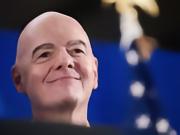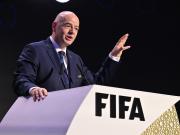
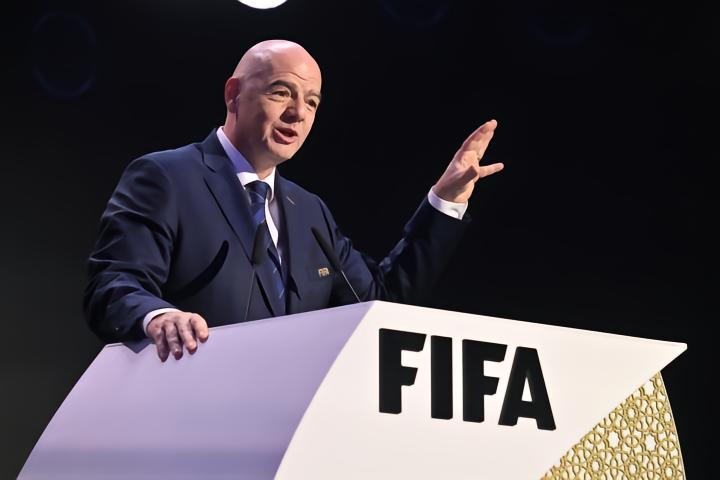
According to Sky News reporter Rob Harris, FIFA President Gianni Infantino's position remains quite secure.
Rob Harris's column
Gianni Infantino is embroiled in the controversy surrounding the sale of his World Cup stake, which adds a layer of intrigue to his response during an interview with me on the eve of the World Cup. The FIFA president proactively addressed accusations that FIFA funds were being used to garner votes.
But my questions at the time only revolved around ticket prices, and did not involve his personal power, nor did they imply that he had any ulterior motives for extracting high revenue from fans.
But he steered the conversation toward the FIFA presidential election mechanism—the 211 member national football associations have equal say, whether you are Spain, ranked number one in the world for men's football, or San Marino, ranked at the bottom. In Mexico City this June, Infantino responded to me, saying, "I've also heard people say things like, 'This money is just given to the football associations to consolidate their power.'"
"Then you should talk about it. Otherwise, where should this money go? Should it be used to fund corruption? I don't think so. The money must be distributed to the respective football associations and will be subject to supervision, and invested in causes that bring hope and dreams to children."
He went on to say, "If we embrace democracy, we must accept the principle of 'one person, one vote'... I know there are places in the world that have had practices similar to those of the Middle Ages—you know which places—where the rich had more votes than the poor. I don't know if you want to go back to that system, or perhaps some of you would?"
He may be alluding to certain countries that haven't achieved full democracy today, or he may be referring to the era centuries ago when the British working class was disenfranchised. This precisely exposes Infantino's dissatisfaction with British accountability, accusing them of lecturing from a moral high ground. Infantino will also portray his re-election campaign as a conspiracy by European powers. UEFA is working together to remove him: from issuing a declaration of no confidence and withdrawing support for his re-election to threatening legal action against Infantino and his close associates.
However, a unified front to overthrow FIFA's current leadership has not formed globally, and the current leadership does not have a majority in the vote. Even assuming that all 90 members of UEFA and CONCACAF would oppose Infantino in next year's confidence vote or presidential election, this only corresponds to the public statements made by the two federations last Saturday, and is still far from the support of half of the football associations. Therefore, Infantino still holds considerable power and maintains a hardline stance.
Since being forced to abandon the World Cup share sale plan, he has neither responded to criticisms of his leadership nor apologized for the "fire sale" deal questioned by European, Asian, and North American clubs. He has not proactively defended his actions, nor has he emphasized his efforts to generate revenue for member associations in the absence of financial support from major European football powers.
Even within the UK, only the Football Associations of England and Wales have publicly announced the withdrawal of their support for him. The Swiss Football Association is also cautious about its own national's president and requires further consultation before deciding whether to abandon its electoral support.
Is it possible for Infantino to weather this crisis?
This may mean that for the first time since Gianni Infantino succeeded the infamous Sepp Blatter in 2016, there will be a competitor in the FIFA presidential election – the Swedish Football Association has confirmed that UEFA is looking for a suitable candidate.
The FIFA annual congress at that time may no longer be the bland, routine gathering of the past, but rather, like a parliament, where dissenting voices will emerge.
However, UEFA has already demonstrated its ability to weaken Infantino and FIFA: it has formally threatened legal action against the latter's plan to establish a World Cup spin-off company. European national football associations may still boycott FIFA-affiliated events, including the U20 Women's World Cup to be held in Poland a month later.
But it appears that Infantino is using his political connections to garner support, with Qatar (his permanent office), Lebanon (which granted him citizenship last year), and Morocco (where FIFA has a regional headquarters and is a co-host of the 2030 World Cup) having publicly expressed their support for his leadership.
Will he seek the support of "King of Soccer" Trump?
Rumors circulated within football circles that Gianni Infantino was scheduled to speak with US Secretary of State Marco Rubio on Monday. Although the Iran issue is a top priority for the US State Department, Assistant Secretary of State for Global Public Affairs Dylan Johnson stated that "there are currently no plans for a call." Was this call ever even possible? Since announcing the termination of the $20 billion World Cup equity sale project early Saturday morning, Infantino has remained silent.
If UEFA does not push for a vote of no confidence, will Infantino persist until the next presidential election?
UEFA has not backed down, and this "civil war" that could last until 2027 may deal a heavy blow to football, especially given the many pressing issues that need to be addressed, such as the approval of the hosting rights for the 2035 Women's World Cup. Although Gianni Infantino's presidency seems precarious, not everyone in the world is against him, which makes UEFA's efforts to remove him much more difficult.